Responsibilities of Employers, Colleges and Employees
It’s alarming to me that Generation Z (Gen Z) employees are being fired shortly after they start their jobs. I was curious about the reasons, so I did some research and produced a variety of things as discussed below.
What’s the Problem?
Virtually all of the articles that I have read blame a perceived lack of professionalism and poor communication skills, including a lack of motivation and the drive to succeed. Gen Z has a reputation for being challenging to work with and difficult to manage.
According to a report in August 2024, Intelligent.com surveyed 966 business leaders involved in hiring decisions at their company to explore attitudes toward hiring recent Gen Z college graduates.
Here’s what they found:
- 75% of companies report that some or all of the recent college graduates they hired this year were unsatisfactory.
- 6 in 10 companies fired a recent college graduate they hired this year.
- 1 in 6 hiring managers say they are hesitant to hire from this cohort.
- Hiring managers say recent college grads are unprepared for the workforce, can’t handle the workload, and are unprofessional.
- 1 in 7 companies may refrain from hiring recent college graduates next year.
- 9 in 10 hiring managers say recent college graduates should undergo etiquette training.
In 2024, 94% of companies reported hiring recent college graduates. Among these companies, only 25% state that all recent college graduate hires worked out well, while 62% mention that only some were successful. Further, 14% report that only a few or none of the hires were successful.
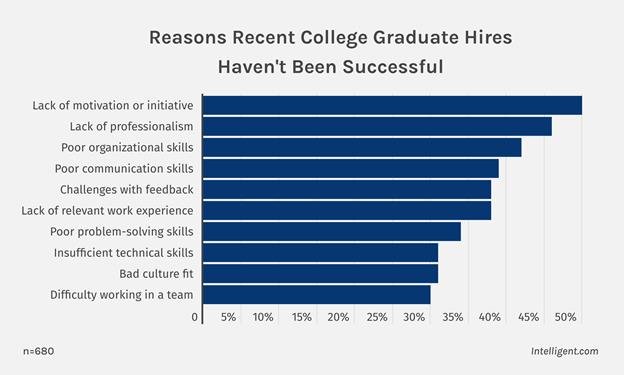
Here are the complete findings about the reasons Gen Zers have not been successful.
Employer Complaints
Employers complain that young people today lack motivation or initiative—50% of the leaders surveyed cited that as the reason why things didn’t work out with their new hire. However, the complaints go much deeper and include the following.
- Difficult to manage.
- Unprofessional
- Unorganized
- Poor communication skills
- Unprepared for the level of work
- Lack of networking skills.
- Poor time management
- Wearing inappropriate clothing to the office
- Using inappropriate language in the workplace.
What Can Be Done by Employers
Because Gen Z is set to become the future leaders, firing them is not the answer. It could even set them up as competition. Michael Ryan, a finance expert and the founder of michaelryanmoney.com, called the decision to fire Gen Z-ers a “critical strategic error.”
“The perceived challenges with Gen Z workers, such as communication style differences or misaligned expectations, are not generational flaws,” Ryan told Newsweek. “But rather symptoms of a larger failure in talent management and organizational adaptability. Forward-thinking companies need to view these as opportunities for organizational evolution, rather than grounds for termination.”
To cultivate Gen Z employees, Ryan said companies should invest in their onboarding and mentorship programs and tailor them to Gen Z’s perspective and skills. “Leverage Gen Z’s digital status to drive innovation from the bottom up. Implement reverse mentoring programs and create cross-generational teams to foster knowledge transfer and spark creative problem-solving,” Ryan said.
There is more that employers can do to help employees to respond to the expectations in the workplace, including the following.
- Develop a new style of leadership that incorporates the skills employees bring to the workplace.
- Adjust employers’ approach to act more as coaches rather than traditional supervisors.
- Develop a mentorship program.
- Create outreach programs to better support and guide younger workers.
Since Gen Zers now outnumber Baby Boomers in the workplace and are expected to comprise 30 percent of U.S. workers by 2030, employers will need to adapt to them, not the other way around, according to Joy Taylor, the managing director at consulting firm, Alliant. Taylor said, “…this is a huge mistake…mastering intergenerational workflows will be crucial to tackling the most anticipated business challenges in 2025, from succession planning to culture realignment.”
Work-Life Balance vs. Work-Life Harmony
Taylor went on to say, “By resisting this workforce change, too many Gen X or Baby Boomer leaders are failing to set their organizations up for long-term success and resiliency, as well as missing out on the opportunity to harness this new generation’s potential. We know Gen Z workers in general have a unique perspective on life and often view their personal activities and goals above those of their employers. While this certainly isn’t a bad thing, if it bleeds too much into your workspace, it can dramatically affect performance and lead to those employees being shown the door.”
Research has consistently shown that a healthy “work-life balance” is vital for maintaining job satisfaction and avoiding burnout. However, a new study suggests that the idea of “work-life balance” itself may be a problem. The standard concept of work-life balance is often seen as a zero-sum game, where work and life are completely separate domains that are constantly competing for time, motivation and energy.
In contrast, the concept of “work-life harmony” visualizes work and life roles as being interconnected and dependent on each other, rather than separate and in competition.
In a recent study, psychological scientists He Lu Calvin Ong (Nanyang Technological University) and Senthu Jeyaraj looked at the effects of work-life balance and work-life harmony styles on worker productivity. The researchers used measures of creativity as indicators of employee productivity and cognitive dissonance as a measure that employees were suffering from work-life stress. In other words, employees experience a mental discomfort when their beliefs, opinion or values are inconsistent with their actual behavior.
For the study, 100 participants filled out a series of online questionnaires. Participants were presented with a typical work-life problem — asking the boss for time off to take care of a sick family member. The results showed that participants who received a response from the “manager” that took a work-vs-life approach (along the lines of work-life balance) reported higher levels of cognitive dissonance. The researchers hypothesized that this resulted from the stress of having to decide between work and home. This group also experienced a drop in creativity after responding to the work-life problem.
On the other hand, participants who received a response that reflected a more integrated work-life approach (along the lines of work-life harmony) did not report changes in their levels of creativity or cognitive dissonance.
How About Colleges and Universities
“Colleges don’t teach students how to behave in the workplace, and there is a lack of transitional support from both universities and employers,” says Resume.org Career Coach Irina Pichura. “Most students graduate with little exposure to professional environments, so when they arrive at their first job, they’re often learning basic workplace norms for the first time. Colleges should have a workplace training program to support graduates’ transition to the workplace.”
There are more concrete steps universities can take to better prepare their graduates for a successful career.
- Provide greater guidance on what to expect in the job search and interviewing.
- Teach graduates how to handle networking conversations.
- Discuss how to behave in the workplace.
- Provide a more relevant curriculum that better prepares graduates for the job market.
- Develop a curriculum that is not focused as much on traditional career paths and more on digital fluency.
Conclusion
The real issue may not be Gen Z’s readiness but a broken system that’s failing to prepare and guide them. However, until employers rethink how they onboard, train, and communicate with new hires, high turnover rates among young workers are likely to continue.
“It’s easy to fall into the trap of stereotyping or writing off younger workers too quickly,” says Huy Nguyen. Structured onboarding, clear communication about workplace expectations, and mentorship can make a dramatic difference in setting Gen Z up for success — not just survival — in their first jobs.”
Blog posted by Steven Mintz, Ph.D, Professor Emeritus from Cal Poly San Luis Obispo, on October 17, 2025. Find out more about Steve’s activities at: www.stevenmintzethics.com.
Pingback: Gen Z firings hit records and bosses blame 9 habits – The Daily Overview
As a hiring manager, I see firsthand what this study highlights. Many Gen Z employees enter the workplace with strong intelligence and fresh perspectives — but often without the readiness and professional habits needed to succeed. At times, new hires neither connect with their managers nor take initiative, yet quickly escalate concerns instead of aligning and learning.
However, this challenge is not one-sided. It’s a shared responsibility between colleges, employers, and employees to bridge the gap.
What Employers Can Do
•Structured onboarding — clear expectations, practical orientation to workplace culture
•Active mentorship — someone they can rely on to navigate early uncertainties
•Frequent feedback — not just annual reviews, but weekly alignment
•Work harmony, not imbalance — flexibility with accountability
What New Employees Should Do
•Own the role — show initiative, ask questions, stay engaged
•Professional communication — connect with managers before escalating issues
•Respect timelines & workload — learning resilience is part of career growth
•Seek feedback proactively — improvement is a two-way process
What Colleges Can Strengthen
•Real-life internships and projects
•Etiquette and workplace behavior training
•Communication and collaboration skills
Instead of labelling a generation, we must build a system that supports professional readiness. When expectations are clear and commitment is mutual, Gen Z doesn’t just survive — they thrive.
Samantha Reddy
These are excellent points. Thanks for your contribution to the discussion.
Excellent points!
Thanks for your contribution.
My brother’s Gen z and millennial employees lead to constant undue stress on him. Their lack of work ethic and taking responsibility for doing their jobs right, or even showing up. Made him constantly having to pick up their slack working 10 hours or more daily with no time off. This constant poor work ethic of these spoiled brats, lead to his untimely death at the age of 54… He was kind and funny a super supportive boss and they couldn’t bother to be better employees. So these entitled brats are costing their bosses their lives and any time they could have spent with their families.
Kathleen, I am so sorry about your brother. It’s a story I hear more and more over the years. Developing a good work ethic needs to start in early education and strengthened by family and friends who are of a like mind. My best wishes are with you. Steve M.
Pingback: Why managers are cutting Gen Z so fast, and the behaviors behind it – The Daily Overview
Thanks for the information, which is quite interesting.
You are most welcome.
Good points. Thanks for sharing!